
The Mazarrón Shipwrecks
Dated to the second half of the seventh century BC, when the Phoenician influence in Spain was at its height, the two Mazarrón shipwrecks and the remains of a larger vessel at Bajo de la Campana were found off the coast of the Region of Murcia, and are three of only six Phoenician ships so far discovered in the Mediterranean.
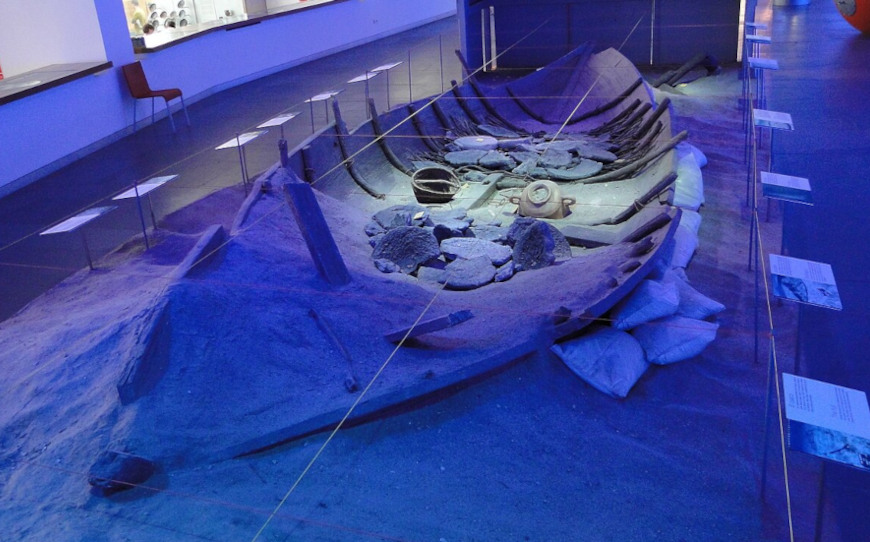
The Mazarrón I shipwreck was first located in 1988, and after being extracted from the seabed and restored is now permanently displayed at the National Museum of Underwater Archaeology (ARQVA) in Cartagena. Despite the limited remains of Mazarrón I and its poor state of preservation, the ship’s origin is clear from its cypress, fig, olive and pine wood structure using materials and construction techniques native to the Phoenician homeland.
In 1994, a second shipwreck was found in a far more complete condition, and while its cargo was removed for study and exhibition, the Mazarrón II wreck was protected for many years by purpose-built sealed metal casing before it was finally recovered from the ocean floor in late 2024.
The contents of Mazarrón II included 1,797 lead ingots, a byproduct of silver production and commercially valuable in its own right, a unique wood and lead anchor, a silver scarab ring, and amphorae containing the fermented fish sauce later known as garum by the Romans, which was famously popular across the ancient world. These artefacts are also exhibited at Cartagena’s National Museum of Underwater Archaeology.
Both Mazarrón I and II were Phoenician ‘hippoi’ - small and versatile merchant vessels about eight metres long and built to maximise cargo capacity. They were used for coastal trade and to transport heavy cargo to larger Phoenician ships anchored in deeper water offshore. The name hippoi derives from the Greek word hippos meaning horse, and refers to the carved horse heads that decorated the bow of these boats.
The Centro de Interpretación del Barco Fenicio (Phoenician Ship Interpretation Centre) located in Puerto de Mazarrón, Cartagena was established in 2009, and offers a wealth of information in both Spanish and English about the Mazarrón shipwrecks and their discovery, including a small-scale replica of the Mazarrón II vessel. Entry to the visitor centre is free of charge.
The Bajo de la Campana wreck was a much larger ship, 15-20 metres in length and built for long-distance trade. It is best known for its spectacular contents including elephant tusks inscribed with Phoenician names and votive messages, and will be covered separately on phoenicians.es soon.