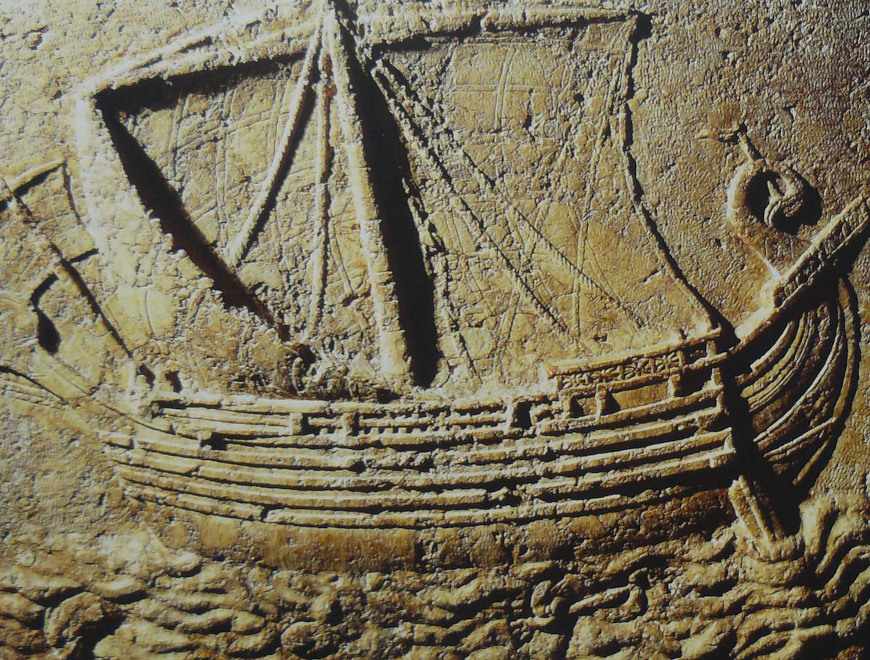

The Bajo de la Campana Shipwreck
The Bajo de la Campana shipwreck was first identified in 1958 by salvage divers, and its cargo was extracted from the 1970s onwards until it was fully excavated between 2007 and 2011, making it the first Phoenician wreck to be recovered from the Mediterranean seabed by archaeologists. Dating from the seventh century BC, the ship sank near Cartagena off the south coast of Spain after running into an underwater rock reef known for causing a number of shipwrecks throughout history.
Bajo de la Campana was a large Phoenician merchant vessel, 15 to 20 metres in length, designed for long-distance trade between the Eastern and Western Mediterranean. The unique cargo featured a mix of raw materials such as ivory tusks, tin and copper ingots (used to make bronze), lead ore and lumps of Baltic amber, as well as a range of luxurious finished goods including the bronze remains of a Phoenician bed or couch.
The shipwreck is probably best known for its sixty-odd North African elephant tusks, some of which are inscribed in the Phoenician alphabet with names and votive messages, suggesting that they came from or were destined for a religious sanctuary. The rest of the raw ivory would have been used to manufacture valuable items like knife and dagger handles (one of which was found in the wreck), boxes, ornaments, jewellery and religious objects.
Highlights of the manufactured goods found in the wreck include prestigious Egyptian alabaster jars often found in elite Phoenician tombs and used to hold oils, ointments and perfume, decorated ostrich eggshells used as drinking vessels and high-status grave goods, and the cast bronze legs and corners of one or more pieces of furniture. A considerable number of metal weight sets, an essential tool for Phoenician merchants weighing metals and other precious commodities, were also recovered.
Among other relics from Bajo de la Campana are fragments of a bronze cauldron and two bronze incense burners (thymiateria), a carved stone pedestal or altar stone made up of three parts, and a number of double-ended boxwood combs used for grooming and particularly to remove lice. The remains of olives, almonds and pine nuts were identified providing insight into the diet of Phoenician sailors, along with numerous ceramic fragments of lanterns, amphorae, wheel-turned plates, bowls, jugs, oil and perfume bottles, and cooking pots.
Bajo de la Campana is one of only six Phoenician shipwrecks so far discovered in the Mediterranean, and a much larger vessel than the other two wrecks found in Spanish waters (Mazarrón I and II). The diverse and valuable cargo underlines the scale and complexity of Phoenician commerce in Spain, and can be seen alongside the ship’s surviving structural materials at Cartagena’s National Museum of Underwater Archaeology (ARQVA).