Princess Europa and the Naming of a Continent
Few people today realise that the European continent is named after a beautiful Phoenician princess. In classical mythology, Europa was the daughter of King Agenor of Tyre, the Phoenician city state from which she was abducted by the supreme Greek god Zeus (Roman Jupiter) and taken to the island of Crete in southern Europe, later giving birth to three children including the legendary King Minos. The Minoan civilization that he founded (c. 3100-1100 BC) is widely regarded as the earliest advanced society in Europe.
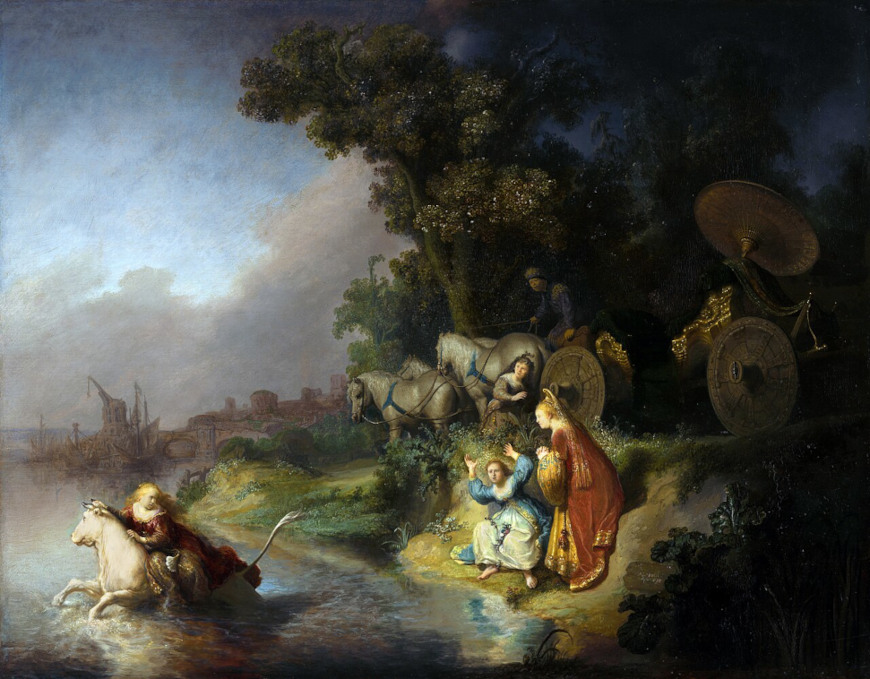
Paintings and literary works depict Europa picking flowers in the palace gardens when she catches sight of a white bull among her father's herd. Zeus has transformed into the form of a bull to attract Europa, who, captivated by the animals beauty and gentle nature, innocently climbs on its back, at which point the bull charges into the sea and carries her to Crete. Zeus then reveals himself to Europa before seducing or raping and eventually deserting her, later forming the shape of a white bull in the stars, the constellation Taurus, in her honour (the planet Jupiter also has a moon called Europa).
After Zeus returned to Olympus, Europa married King Asterion of Crete who became the stepfather of her three children, Minos, Rhadamanthu and Sarpedon. The long and enlightened rule of King Minos was only soured by his wife insulting the god Poseidon, who put a curse on the queen that ultimately led to the birth of the Minotaur. This savage beast with the body of a man and the head of a bull forced the Cretan King to build the inescapable Labyrinth as a prison, before the Athenian hero Theseus successfully navigated the maze and killed the monster.
Two of Europa’s brothers who set off in search of her after Zeus’s abduction became famous in their own right, Cadmus for introducing the alphabet to Greece and founding the city Thebes, and Cilix who settled in Asia Minor and established the region of Cilicia.
The story of Europa is immortalised in artworks such as Titian’s The Rape of Europa, showing the princess being carried into the sea on the back of the bull, and paintings depicting the same scene by Rembrandt, Peter Paul Rubens, Goya and Paolo Veronese. A seventh century BC vase painting has been identified as Europa, and she is mentioned in Homer’s The Iliad written around the same time. Greek and Roman authors also told the story of Europa including the historian Herodotus and the poet Ovid.
This founding myth for the European continent is a legend that is probably based on truth, exploring the eternal storytelling elements of sexual desire or seduction, violence and the supreme power of the gods. Most importantly, the abduction of the Phoenician princess Europa symbolises the transfer of knowledge, culture and ultimately civilisation from east to west.