About Trayamar
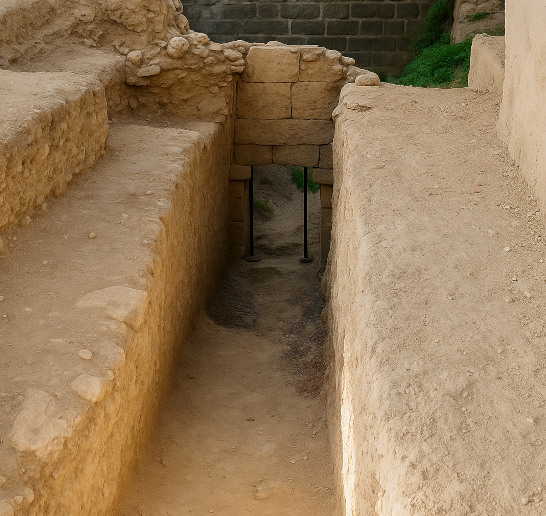
Trayamar is considered to be the most important Phoenician necropolis in the Western Mediterranean, consisting of five underground burial chambers (hypogea) dating from the seventh century BC, which were periodically reopened to add the cremated and interred remains of family members over generations.
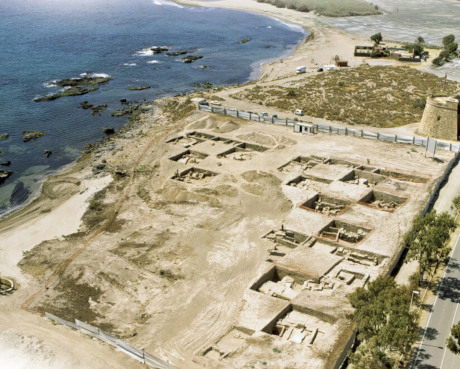
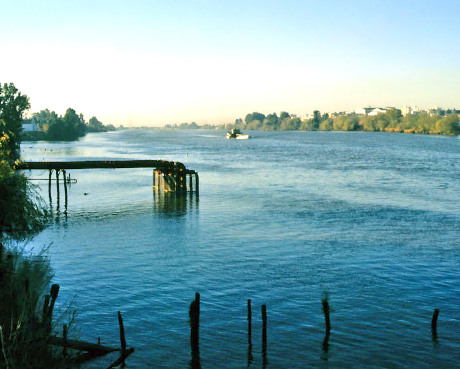
The elaborate construction of the Trayamar tomb complex and its contents points to a prosperous Phoenician elite who resided in the area for hundreds of years. They almost certainly lived in the Morro de Mezquitilla urban settlement, which sits on the opposite side of the Algarrobo River and is visible from the hilltop of the Trayamar necropolis.
Trayamar’s rock-cut tombs feature rectangular chambers constructed with imposing ashlar limestone blocks, a sealed door leading to an access ramp, and a wooden roof likely capped by a small earth and stone mound. The coexistence of cremations and burials reflects the evolution of Phoenician funerary practices.
Originally identified as a Phoenician necropolis in the 1930s, the Trayamar estate was excavated in 1967 and 1969 by the German Archaeological Institute of Madrid. These excavations confirmed the existence of five chamber tombs in close proximity, of which only one now survives after the others were carelessly destroyed during agricultural work.
Fortunately, the archaeologists managed to document the most important tombs before their destruction, and they questioned the estate’s workers for descriptions of the others. While different techniques were used in the construction of the Trayamar tombs, they all featured a rectangular underground chamber and an eastward orientation towards Morro de Mezquitilla, with ashlar stone walls sunk up to 4.5 metres deep in the ground.
The tombs contained typically Phoenician grave goods, such as alabaster urns and red-slip amphorae used to hold cremated remains, mushroom-lipped and trefoil (three-spouted) jugs, ostrich eggs, plates, perfume bottles, incense burners, and lamps. Personal objects were also found, including a small ivory box, amber necklace beads, gold jewellery, and the famous Trayamar Medallion.
The scattered bones and broken pottery found in some of the tombs suggest that they were looted both in ancient times and as recently as the late 20th century. Therefore, it is something of a miracle that just five tombs yielded such important relics and evidence of the early Phoenician footprint in Western Europe.
The inspiration for Trayamar’s monumental chamber tombs came from the main Phoenician city-state of Tyre, the ancestral home of the necropolis's occupants, where aristocratic family pantheons were common.
Given the high cost and level of craftsmanship involved in the construction of the tombs and the quality of the grave goods, it is clear that we are dealing with wealthy local elite families, probably in control of industrial production at the workshops in nearby Morro de Mezquitilla, and its flourishing trade in unfamiliar wheel-turned ceramics and crafted metalwork.
These are the most sophisticated Phoenician tombs so far found in the western Mediterranean, revealing the permanent presence of commercial dynasties living in harmony with the indigenous population for hundreds of years in an arrangement that benefitted both parties enormously.
Although the Trayamar tombs date to the seventh century BC, the settlement of Morro de Mezquitilla was founded roughly two hundred years before, suggesting that the earliest Phoenician burials have yet to be discovered.
Estate labourers also reported seeing less extravagant shaft tombs (burials cut into the rock) alongside the chamber tombs during the site's demolition, indicating that the Trayamar necropolis was larger and more socially diverse than current evidence suggests.
The Trayamar Medallion
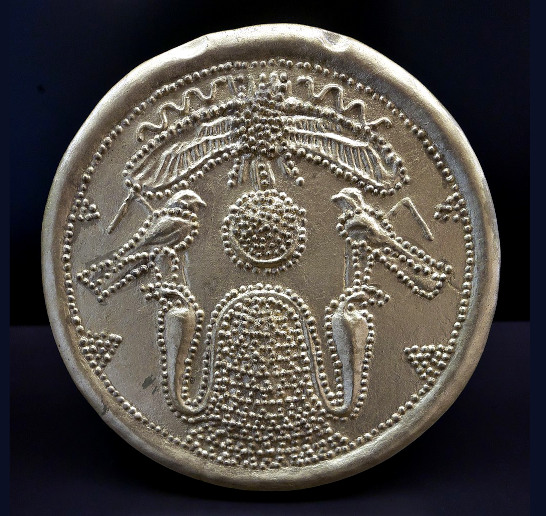
The Trayamar Medallion was discovered during excavations of the Phoenician chamber tombs. The 25-mm solid gold medallion is decorated with Egyptian iconography and solar symbols depicting the soul’s rebirth and immortality. Two falcons perch on cobras emerging from the cosmic mountain, with a sun disk and a crescent moon representing the principal Phoenician goddess Astarte.
The embossed and grained Trayamar Medallion’s theme has given rise to various interpretations. One such interpretation features the winged god Horus appearing to ascend towards the celestial realm, watched over by two snakes symbolizing the Egyptian goddess Uadjet. She is said to have protected Horus and his mother, Isis, when he was a baby after the death of his father, Osiris.
Velez-Malaga
Address
Opening Hours
Tues-Fri: 10 am–2 pm, 5-8 pm
Sat-Sun: 10 am–2 pm
Free admission.
The Museum of Velez-Malaga has a dedicated Phoenician room showcasing artifacts discovered in the Axarquia region of Andalusia, as well as documents, information and 3D models related to the Phoenician presence in the area.
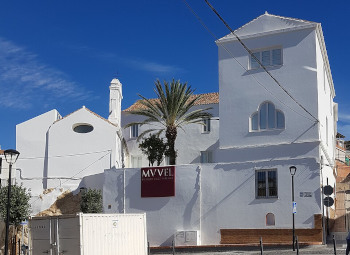
The Museum’s director, Emilio Martin Cordoba, is a leading authority on the Phoenician settlements in Southern Spain, and also organises an annual guided coach tour of the main local sites including Toscanos, Morro de Mezquitilla and Trayamar.
.jpg)